
July 15, 2026 - PBS News Hour full episode
7/15/2026 | 57m 46sVideo has Closed Captions
July 15, 2026 - PBS News Hour full episode
July 15, 2026 - PBS News Hour full episode
Problems playing video? | Closed Captioning Feedback
Problems playing video? | Closed Captioning Feedback
Major corporate funding for the PBS News Hour is provided by BDO, BNSF, Consumer Cellular, American Cruise Lines, and Raymond James. Funding for the PBS NewsHour Weekend is provided by...
July 15, 2026 - PBS News Hour full episode
7/15/2026 | 57m 46sVideo has Closed Captions
July 15, 2026 - PBS News Hour full episode
Problems playing video? | Closed Captioning Feedback
Where to Watch PBS News Hour
PBS News Hour is available to stream on pbs.org and the PBS app.
Providing Support for PBS.org
Learn Moreabout PBS online sponsorshipGEOFF BENNETT: Good evening.
I'm Geoff Bennett.
Amna Nawaz is away.
On the "NewsHour" tonight: President Trump's nominees for U.S.
attorney general and director of national intelligence face contentious confirmation hearings.
SEN.
JON OSSOFF (D-GA): Who won the 2020 election?
JAY CLAYTON, U.S.
Director of National Intelligence Nominee: I have answered.
I have answered.
SEN.
JON OSSOFF (D-GA): Answer it.
What is your answer?
JAY CLAYTON: I have given you my answer.
SEN.
JON OSSOFF: What is your answer?
GEOFF BENNETT: How reporting on security concerns surrounding the new Air Force One landed New York Times journalists with subpoenas and the concerns that is raising about press freedom.
And law enforcement's growing access to camera technology is helping solve crimes, but also raising questions about surveillance and privacy.
JOSH THOMAS, Flock Safety: What's the trade-off we're making in society?
Are we comfortable with that level of trade-off?
And I think those are fair questions to ask.
(BREAK) GEOFF BENNETT: Welcome to the "News Hour."
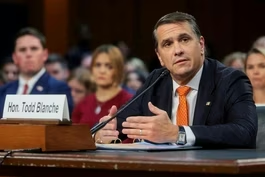
Acting Attorney General Todd Blanche appeared before the Senate Judiciary Committee today for more than five hours of testimony on his nomination to serve permanently in the role.
As justice correspondent Ali Rogin reports, Blanche faced pointed questions about his record as President Trump's personal lawyer, the fate of a proposed settlement fund for people who claim they were targeted by the Justice Department, and his handling of the Epstein files.
SEN.
CHARLES GRASSLEY (R-IA): Do you swear or affirm... ALI ROGIN: Acting Attorney General Todd Blanche took tough questions from both sides of the aisle... TODD BLANCHE, Acting U.S.
Attorney General: I'm here today to earn your trust once more.
ALI ROGIN: ... on his three-month record in the acting role.
SEN.
CORY BOOKER (D-NJ): This isn't a confirmation hearing.
This is more of a performance review.
ALI ROGIN: Up for review, a short-lived settlement of a suit President Trump brought against the IRS in which people claiming politicized prosecutions could apply for part of a so-called anti-weaponization fund.
Blanche has said the fund is dead, but has declined to put it in writing.
SEN.
JOHN CORNYN (R-TX): Has there been a written agreement of the parties to modify the settlement fund?
TODD BLANCHE: No, the settlement fund is just not moving forward.
There's no modification.
It just never started.
No money went from the Treasury to any other account.
There's no commissioners.
It's not moving forward.
SEN.
JOHN CORNYN: But just to be clear, the president of the United States, who's a plaintiff in this lawsuit, has not agreed in writing to delete the weaponization fund.
ALI ROGIN: Blanche also took questions about a rebuke of the fund by a federal judge in Florida, who said the case was brought in bad faith.
She shared her order with the New York State Bar for possible disciplinary action.
SEN.
SHELDON WHITEHOUSE (D-RI): Do you intend to appeal, the Department of Justice?
TODD BLANCHE: We weren't really even part of that decision.
So, to the extent there's something that we can appeal, I very vigorously will encourage the department to do so.
ALI ROGIN: In the hearing room today, a handful of survivors of late convicted sex offender Jeffrey Epstein.
Some of them appeared in a video earlier this week urging senators not to confirm Blanche over his handling of the Epstein files as deputy attorney general.
WOMAN: Todd Blanche failed us.
WOMAN: He failed victims everywhere.
WOMAN: We deserve better.
ALI ROGIN: Those survivors criticized Blanche and the Department of Justice for redaction errors that revealed their personal information, which they say led to re-traumatization and fears for their safety.
Blanche acknowledged those errors.
SEN.
RICHARD BLUMENTHAL (D-CT): Will you apologize to them for the mishandling and mistakes that were made by the United States Department of Justice?
TODD BLANCHE: I will -- I will absolutely say that any mistake that we made should not have been made.
ALI ROGIN: While praising the work of the attorneys who reviewed the files.
TODD BLANCHE: Whenever we learned that any victim's name had been improperly not redacted, we immediately took the document down.
ALI ROGIN: Several lawmakers repeated claims by survivors that the DOJ purposely redacted names of powerful people connected to Epstein.
SEN.
RICHARD DURBIN (D-IL): Your explanation -- quote -- "It isn't a crime to party with Mr.
Epstein."
Mr.
Blanche, these survivors deserve much better.
ALI ROGIN: And urged Blanche to meet with the survivors in the room, which Blanche said he could not do directly.
SEN.
RICHARD DURBIN: Will you meet with these 10 survivors?
I'm asking you on the record.
TODD BLANCHE: If they have lawyers, as you know, I'm prohibited from meeting directly with them.
I have met with counsel for survivors, as has many people in the Department of Justice, over 30.
But if they are represented by counsel, we will work with their counsel.
ALI ROGIN: There were revealing exchanges on many issues before the Department of Justice, but it may be a quick, apparently flubbed response that remains Blanche's most memorable answer.
SEN.
JOHN KENNEDY (R-LA): Are you and President Trump friends?
TODD BLANCHE: I'm his lawyer, was his lawyer, and now I'm the deputy attorney general.
ALI ROGIN: Blanche led Trump's defense team on several cases between his presidential terms, which critics have called a conflict of interest since he joined this DOJ.
One of the cases was special counsel Jack Smith's probe into Trump's involvement in the January 6, 2021, riots.
Blanche said he has recused himself from January 6 cases, but he did move this year to vacate the convictions of 12 of the riot's leaders.
Blanche defended his involvement.
SEN.
ADAM SCHIFF (D-CA): These people were convicted the January 6 investigation, which also involved the president, who you represented.
You were involved in dismissing those cases, were you not?
TODD BLANCHE: I was -- I'm the acting attorney general.
So, yes, my department moved a dismiss.
I was... SEN.
ADAM SCHIFF: So you didn't recuse yourself from that matter.
You were willing.
TODD BLANCHE: There's no reason to -- from the Proud Boys matter?
SEN.
ADAM SCHIFF: Yes, it was.
TODD BLANCHE: You know the rules.
There are rules that say when I have to recuse.
SEN.
ADAM SCHIFF: Yes, there are rules.
TODD BLANCHE: And that's not one of them.
ALI ROGIN: Blanche needs the support of all committee Republicans in order to make it to a full Senate vote.
Two of them, Thom Tillis and John Cornyn, lost their primaries and were viewed as wild cards going into the hearing.
Cornyn told reporters he still has concerns, but Tillis seemed supportive.
SEN.
THOM TILLIS (R-NC): Thank you, Mr.
Blanche.
You have done a great job today.
ALI ROGIN: The committee reconvenes tomorrow for a second day, where they will hear from Blanche's supporters and critics.
SEN.
CHARLES GRASSLEY: Meeting adjourned.
TODD BLANCHE: Thank you, Senator.
ALI ROGIN: For the "PBS News Hour," I'm Ali Rogin.
GEOFF BENNETT: Another Trump nominee for a top post faced senators today.
U.S.
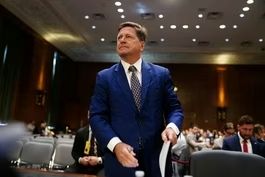
attorney Jay Clayton appeared before the Senate Intelligence Committee for his confirmation hearing to become director of national intelligence.
The job is largely focused on foreign threats and national security.
But, as Nick Schifrin reports, much of today's hearing focused instead on the recent past.
NICK SCHIFRIN: Today on Capitol Hill, a hearing that was supposed to be about the future of the intelligence community was instead dominated by the history of the 2020 election.
SEN.
JON OSSOFF (D-GA): Who won the 2020 election?
JAY CLAYTON, U.S.
Director of National Intelligence Nominee: I'm not going to do this with you.
NICK SCHIFRIN: Jay Clayton is the president's nominee for director of national intelligence, a lawyer with more than 30 years of experience, President Trump's first chairman of the Securities and Exchange Commission, and most recently U.S.
attorney for the Southern District of New York, one of the Justice Department's most prestigious roles.
SEN.
MARK WARNER (D-VA): Do you deny that Joe Biden won the 2020 election?
JAY CLAYTON: Senator, I'm not an election denier.
Joe Biden was certified as the president of the United States.
NICK SCHIFRIN: And yet repeatedly in response to Democratic senators, Clayton refused to use the word won to describe Joe Biden and the 2020 election.
SEN.
JON OSSOFF: Who won the 2020 election?
JAY CLAYTON: I have answered.
I have answered.
SEN.
JON OSSOFF: Answer it.
What is your answer?
JAY CLAYTON: I have given you my answer.
SEN.
JON OSSOFF: What is your answer?
You refuse to answer a basic question about who won a presidential election.
JAY CLAYTON: No, I think... SEN.
JON OSSOFF: But you ask to lead America's intelligence community?
Isn't it humiliating to be unable to answer this question, to have to indulge the president's delusions?
DONALD TRUMP, President of the United States: I say it was rigged, just like the election was rigged in 2020.
NICK SCHIFRIN: Since 2020, President Trump has claimed he won that election.
And "PBS News Hour" has learned that, tomorrow night, he will unveil new purported details in what he has long claimed without hard evidence was fraud.
Part of the president's efforts to find fraud ensnared his last director of national intelligence, Tulsi Gabbard.
She says that President Trump directed her to observe an FBI raid on an election office in Fulton County, Georgia.
By statute, the director of national intelligence is barred from participating in domestic law enforcement or intelligence collection.
SEN.
JON OSSOFF: Are you aware that former Director Gabbard testified that her presence at the raid was -- quote -- "requested by the president"?
JAY CLAYTON: I'm not aware of that until now.
NICK SCHIFRIN: That did not sit well with Virginia Democrat and committee Vice Chairman Mark Warner.
SEN.
MARK WARNER: And I trust you.
I know you, but it strains credibility to think that you were not aware of Director Gabbard's intervention in a domestic election activities in Fulton County.
JAY CLAYTON: To be clear, the ODNI's role is principally outside the United States.
NICK SCHIFRIN: There are other vital issues concerning the Office of the Director of National Intelligence, including its size and scope.
Recently, acting Director Bill Pulte launched a wave of firings, a downsizing driven by President Trump and supported by Intelligence Committee Chairman Arkansas Republican Tom Cotton.
SEN.
TOM COTTON (R-AR): The ODNI has unfortunately become yet another bloated agency that incentivizes bureaucratic make-work as opposed to genuine intelligence work.
JAY CLAYTON: There needs to be a place of oversight, a place to resolve conflict.
I look at it as a board of director's role.
And to the extent that the ODNI has gotten into operations or started to play the roles of some of those other agencies, it probably should pull back.
NICK SCHIFRIN: The Intelligence Committee is expected to vote on Clayton's nomination early next week.
He would need all nine Republican votes if the committee's eight Democrats all opposed his nomination.
For perspective on today's hearing, we turn to Fred Fleitz, who had a 25-year career in the intelligence community.
During the first Trump administration, he was deputy assistant to the president and chief of staff to the National Security Council staff.
He is now vice chair of the American Security at the America First Policy Institute.
Fred Fleitz, thanks very much.
Welcome.
FRED FLEITZ, Former CIA Analyst: Good to be there.
NICK SCHIFRIN: Is Jay Clayton the right person for the job?
FRED FLEITZ: I think so.
I was very impressed with him today.
He came off as a distinguished leader, a distinguished manager, someone who has a very good rapport with Congress, who has experience dealing with congressional oversight.
He also talked about his intelligence experience, his work as a judge dealing with counterterrorism, narcotrafficking.
I think this makes them a good choice and someone who will help implement the president's desire to reform and downsize the Office of Director of National Intelligence.
NICK SCHIFRIN: Let me ask, though, about the number of times that Clayton was asked by Democratic senators, also Angus King, an independent who caucuses with the Democrats, about whether Biden -- quote - - "won" the election in 2020.
Clayton refused to use that word, instead saying Biden was -- quote -- "certified."
What do you make of that?
Is that important?
FRED FLEITZ: I think it's a shame that the Democrats, six years after the 2020 election, still want to make an issue out of that.
The Democrats want to make an issue over who won the election.
Really, they wasted a hearing, which was an opportunity to discuss serious national security issues.
I just think they are trying to use this hearing to create talking points and sound bites for the next for the next election and the midterm.
NICK SCHIFRIN: Does it concern you about the most recent director of national intelligence, Tulsi Gabbard, that she got involved in domestic politics?
There is a lot of evidence that you and I have talked about over the years that foreign adversaries have tried to influence elections.
But the Senate Intelligence Committee, the intelligence community itself has always said that there's no evidence that any foreign actors manipulated any votes.
Does it concern you if the director of national intelligence is involved in domestic politics?
FRED FLEITZ: Well, there's pretty substantial intelligence that many nations, China, Iran, and Russia, have tried to influence the outcome of our elections.
Did it make a difference in the outcome?
Well, that's something we can debate and look at the information.
I think that our intelligence community has a responsibility to make sure that, if there are hostile powers trying to affect the outcome of our elections, especially presidential elections, they need to do that.
NICK SCHIFRIN: All right, let's zoom out.
Let's zoom out.
Clayton and Chairman Cotton of Arkansas talked about the need to cut the size of the staff of the director of national intelligence, as you mentioned before.
Why do you think that's important?
FRED FLEITZ: I like the way Cotton began this debate.
He said that the ODNI, the Office of Director of National Intelligence, is a wasteful and unnecessary layer of bureaucracy.
He would like to see it numbered in the teens, if not the hundreds.
Right now, there are thousands of bureaucrats working in this bureaucracy.
I was with the CIA for 19 years.
I really don't know what this bureaucracy does.
When I was on the House Intelligence Committee, I just noticed they sent in tons of senior officials, so many of which, when we had a witness table, we couldn't fit all the ODNI and other intelligence community officials.
So many officials, so many cooks stirring the soup makes it very difficult to get intelligence out quickly to the president when he needs it.
We need to have a streamlined and effective U.S.
intelligence community.
The ODNI, instead of being a small coordinating office to make sure the intelligence agencies share information -- that's what the 9/11 Commission wanted -- it now produces intelligence.
It has the National Intelligence Council.
It has issue managers who do the same thing on regional issues and on functional issues.
I think Senator Cotton is exactly right.
He has a very good bill on how to pare down the ODNI.
NICK SCHIFRIN: And do you think the president will support Clayton being a strong director of national intelligence, even as the structures will reduce in size, at the very least?
FRED FLEITZ: I think Clayton will get similar directions from the president that Pulte did, to basically right-size this organization, so intelligence is lean and mean and gets the president what he needs quickly and without political influence.
NICK SCHIFRIN: Fred Fleitz, thank you very much.
FRED FLEITZ: Good to be here.
GEOFF BENNETT: In the day's other headlines: A White House official tells the "News Hour" that President Trump has overturned the temporary pause on ICE traffic stops.
On social media, Mr.
Trump praised the practice, calling it -- quote -- "one of ICE's most important and effective crime-fighting tools."
The agency said yesterday that it would suspend most stops after two fatal shootings within a week.
In both instances, ICE agents were also not wearing body cameras.
Today, the DHS said that, moving forward, all ICE arrest teams will have at least one agent with a body camera.
The U.S.
military launched multiple waves of new strikes against Iran today, the third wave in 24 hours.
U.S.
Central Command said overnight and daytime attacks targeted dozens of Iranian missile and defense sites.
Iran launched its own wave of strikes on Gulf nations overnight and has threatened to disrupt all energy exports from the Middle East.
President Trump has signaled that he would broaden attacks next week to include civilian targets like bridges and power plants.
On a visit to Pennsylvania today, Mr.
Trump said he isn't giving Iran a deadline to return to the talks.
DONALD TRUMP, President of the United States: I don't like giving deadlines, but they pretty much know.
They know the story.
They better behave.
GEOFF BENNETT: For its part, Iran's Foreign Ministry said today it has no plans to negotiate.
Meantime, the U.S.
naval blockade entered its first full day back in effect.
The U.S.
military said today that its forces fired on and disabled an oil tanker trying to break the blockade.
Here at home, the intestinal parasite that has spread to at least 34 states was a topic on Capitol Hill today.
Dr.
Erica Schwartz, the Trump administration's nominee to lead the CDC, told the Senate Health Committee she'd use -- quote -- "radical transparency" to rebuild public trust in the agency.
When asked about the CDC reducing its mandatory reporting of cyclosporiasis last year, Dr.
Schwartz said she had not been aware, but vowed to address the outbreak.
SEN.
PATTY MURRAY (D-WA): You commit to reinstating the required reporting for cyclospora?
DR.
ERICA SCHWARTZ, CDC Director Nominee: You have my commitment to work with your staff and work with the CDC scientists to understand what can be done, why did it stop, and what can we do moving forward.
SEN.
PATTY MURRAY: We shouldn't need thousands of people to get severely ill before we reinstate programs and systems that were haphazardly canceled.
GEOFF BENNETT: The CDC has confirmed more than 1,600 cases and is looking further into more than 5,000 other suspected cases.
Heavy smoke from several wildfires burning in Canada and Minnesota is causing unhealthy air for millions of people across the Midwest and Northeastern U.S.
In places like Upstate New York, hazy skies have reduced visibility and affected traffic.
The National Weather Service is advising people in affected areas to stay indoors.
Intense heat and drought conditions have fueled large fires across at least 15 states.
In Minnesota, fire officials say that shifting conditions on the ground mean they're having to prioritize which fires to put out first.
NICK PETRACK, Superior and Chippewa National Forests: I highly feel like this is going on for a while, so I do ask for patience.
As the weather does what it wants to, we have to be able to react with the situation with the public and firefighter safety as our number one priority.
GEOFF BENNETT: Meantime, satellite footage shows storms moving across Southern Texas today, where torrential rain has caused potentially life-threatening floods.
Forecasters say as much as 20 inches could fall before the storms ease by Friday.
Defense Secretary Pete Hegseth says the Pentagon will start testing U.S.
soldiers 30 and older for testosterone deficiency.
In a video announcement with text that reads "The High T Department of War," Hegseth said the screenings would be part of a mandatory annual health assessment.
He added that any recommended treatment, including hormone replacement therapy, would be optional.
PETE HEGSETH, U.S.
Defense Secretary: This initiative, it's not about artificial enhancement.
It's about restoring and optimizing your natural capabilities.
GEOFF BENNETT: Current medical guidelines generally advise against blanket testosterone screenings.
The U.S.
Treasury announced today that it will begin rolling out a new $1 coin featuring President Trump's likeness.
Treasury Secretary Scott Bessent says the coin is part of commemorations marking 250 years of American independence.
Despite its gold-like finish, Treasury says the coin contains no actual gold.
Federal law prohibits the U.S.
Mint from putting the likeness of a living person on currency, but Bessent says the new coins are permitted because they are commemorative.
The coin is expected to enter circulation this fall.
Well, Argentina is through to the World Cup final after a dramatic 2-1 win over England.
The defending champion scored both goals late in the game in a span of about seven minutes; 39-year-old superstar Lionel Messi made the assist on both, adding to his legendary career.
Argentina will face Spain in the final on Sunday, where they will try to be the first men's back-to-back World Cup champions in more than 60 years.
On Wall Street today, stocks ended higher after a series of strong corporate results.
The Dow Jones industrial average added 150 points on the day.
The Nasdaq rose about 150 points.
The S&P 500 also posted a modest gain.
Still to come on the "News Hour": the latest legislative push to make daylight saving time permanent; why fewer Americans are reading for pleasure; and the national youth poet laureate explains how he uses his art to bridge worlds.
Several New York Times reporters were subpoenaed to appear before a grand jury today after the paper published stories raising security concerns about the new Air Force One, a plane gifted to the Trump administration by the government of Qatar.
White House correspondent Liz Landers looks now at the questions the case raises about freedom of the press.
LIZ LANDERS: In some cases, the subpoenas were served by federal agents to New York Times reporters at their homes.
The paper denounced the actions and vowed to fight efforts to compel the reporters to identify confidential sources.
JOSEPH KAHN, Executive Editor, The New York Times: The Trump administration issued subpoenas to five of our journalists in what I think is a naked attempt to intimidate The New York Times and to keep us from reporting on matters that we think are essential to national security.
LIZ LANDERS: Joining us now to discuss this is Will Creeley.
He's the legal director for FIRE.org, the Foundation for Individual Rights and Expression.
Will, thank you for joining "News Hour."
WILL CREELEY, Legal Director, Foundation for Individual Rights and Expression: It's an honor.
Thank you for having me.
LIZ LANDERS: The Justice Department says here that they are targeting the leakers of the classified information in this case and not the journalists.
Acting Attorney General Todd Blanche was asked about these subpoenas today.
TODD BLANCHE, Acting U.S.
Attorney General: The Department of Justice requires that I authorize it, which I did.
And those reporters -- we're not targeting reporters.
They're material witnesses, just like a reporter would be a material witness to a car crash.
There are witnesses.
SEN.
PETER WELCH (D-VT): And the question you want to ask them is, who were their sources?
That goes to the heart of the First Amendment.
TODD BLANCHE: No.
No.
No, the question we want to ask them is, who provided them with classified national security information, which everybody in this body should want to protect.
LIZ LANDERS: What does the law say about what protections journalists have in this case?
WILL CREELEY: Well, the law has been clear for a long time that somebody else's illegal conduct does not remove speech about a matter of public concern, like the president's new jet, from First Amendment protection.
There's no federal shield law, but the heart of the First Amendment does indeed protect this kind of activity.
What we're seeing here should be a last resort.
Subpoenaing reporters is a shot across the bow, designed to get people to stop asking questions about subjects the administration would rather not talk about.
And it's chilling.
LIZ LANDERS: In this case, the subpoenas were issued to these five New York Times reporters and some were served at their homes.
Is that unusual?
And why do you think it was done in that way, in your opinion?
WILL CREELEY: It is unusual, and it's theatrical.
It's designed to send a very clear message.
Stop asking questions, sit down and shut up.
I'm awfully tired of federal law enforcement agents showing up on people's doorsteps about protected speech.
And, unfortunately, this is just the latest in a pattern.
This administration has evinced a real hostility to press that should concern Americans no matter their politics.
It's designed to get people to sit down and be quiet.
LIZ LANDERS: The New York Times has said that it will fight these subpoenas.
How do they do that and what could they argue in court?
WILL CREELEY: Well, 55 years ago, The New York Times found itself in the Supreme Court defending its publication of the Pentagon Papers.
And in deciding that the publication of those papers was protected by the First Amendment, despite the arguments then, like now, that national security dictated otherwise, Justice Hugo Black wrote, the First Amendment was designed by the founders to protect the governed, not the governors.
That's us.
And I hope the First Amendment should -- will protect The New York Times again here.
I imagine The New York Times will fight.
They have called it brazen, and so it is.
LIZ LANDERS: What happens if the reporters refused to testify?
WILL CREELEY: Well, I don't want to speculate, but we shall find out.
I imagine they could be held in contempt.
We will see.
We will be watching closely.
I think, again, every American who cares about a free press, who cares about knowing what's going on with our government should be tuning in.
This isn't an authoritarian dictatorship.
We're not China.
We're not a repressive society where you can't ask questions of our leaders.
We should want to know what's happening with the folks who make decisions that affect our lives, including the president of the United States.
LIZ LANDERS: You mentioned this, but this is not the first time that the Trump administration has tried to subpoena or question journalists about stories that are critical of the administration or the president.
Is this a pattern that you're seeing?
How would you describe this kind of behavior?
WILL CREELEY: Again, the president is in court and his administration is in court against The Washington Post, The New York Times, The Wall Street Journal.
Just last week, my colleagues were in Iowa state court defending a pollster, Ann Selzer, against charges filed by the president alleging that her poll constituted consumer fraud.
It's beyond the pale.
It is a direct attack on the First Amendment's protection of our free press.
In the 250th anniversary of our country, we should demand better.
LIZ LANDERS: How does this administration compare to previous administrations?
I mean, other presidents and other administrations have asked reporters to reveal their sources, but how does this moment compare to those?
WILL CREELEY: That's right.
Other presidents have done it, but this is not something we should get used to.
Just because other presidents have done it, and they have, of both parties isn't a grounds for justification.
We shouldn't normalize this behavior.
We should ask for the freest press we can demand.
That's what we deserve under the First Amendment.
That's what we are guaranteed, beyond deserve.
Again, I think that you have to look at this in the larger context of the president's attacks on the press.
Really almost from day one, attacking the press has been a trademark of his, and the result is a chill on speech.
LIZ LANDERS: Will Creeley, thank you for your expertise.
WILL CREELEY: Thank you so much for having me.
GEOFF BENNETT: Law enforcement agencies across the country use A.I.-powered cameras to scan billions of vehicles each month, often without drivers even knowing they're being recorded.
Supporters say the technology helps solve crimes.
Critics warn its rapid expansion is creating a nationwide surveillance network, raising questions about the balance between public safety and personal privacy.
Paul Solman dives into that debate.
PAUL SOLMAN: A quiet Saturday afternoon last September.
Denver resident Chrisanna Elser gets an alert from her doorbell camera.
A nearby Columbine Valley police officer has come calling.
MAN: Do you know why I'm here?
CHRISANNA ELSER, Denver Resident: No.
MAN: OK.
CHRISANNA ELSER: He pulled out a picture of my truck and accused me of stealing a package.
MAN: We have cameras everywhere in that town.
You can't get a breath of fresh air in or out without us knowing.
PAUL SOLMAN: Police-operated cameras had recorded her driving near the scene of the crime.
Only problem, she had nothing to do with it.
CHRISANNA ELSER: They caught me 20 times driving through the neighborhood that we drive through to go to work every day.
PAUL SOLMAN: Police had simply matched their video with doorbell footage of the theft, showing a blot, like Elser.
CHRISANNA ELSER: Well, can I see this video?
MAN: If you go to court, you can.
If you're going to deny it, I'm not going to extend you any courtesy.
If you're going to lie to me, I am not going to extend you any courtesy.
CHRISANNA ELSER: It was shocking to have somebody come in so strong and rely on the digital evidence.
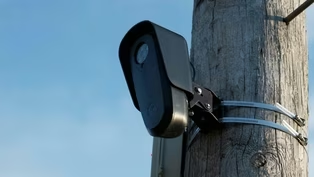
PAUL SOLMAN: Small black cameras mounted on utility poles began appearing around the neighborhood in 2024.
But, so what, says Elser.
CHRISANNA ELSER: I took the stance that everybody else takes that, eh, big deal, it's up there.
If I'm not doing anything wrong, then why am I worried about it?
PAUL SOLMAN: Turns out these cameras extend far beyond Denver.
Today, more than 100,000 are installed across all 50 states, according to crowdsourced data from anti-surveillance organizations, the vast majority owned by security tech company Flock Safety.
NARRATOR: Let's shape a safer future together.
JOSH THOMAS, Flock Safety: We build hardware and software that helps cities solve crime.
PAUL SOLMAN: Flock's Josh Thomas says they make other devices to detect gunshots, for instance, but- JOSH THOMAS: Our bread and butter product is a license plate reader.
We are pinpoint-focused on the back of a vehicle to identify the make model color, the license plate, the state of the license plate.
PAUL SOLMAN: Time stamps, locations.
But Flock's A.I.-powered cameras also record bumper stickers, dents to match against local and national law enforcement hot lists.
JOSH THOMAS: So when there's a wanted person, an outstanding warrant, a hit-and-run, a missing person, they will add those license plates to the list.
So, in real time, if one of those vehicles drives by a Flock Safety device, we will send an alert to local law enforcement.
PAUL SOLMAN: The data is also stored on a searchable cloud database for 30 days.
And so misuse can happen, as with Chrisanna Elser, among others documented in local reporting.
But it's rare, says Thomas.
What's far more common, he says, the technology helps solve crimes.
JOSH THOMAS: They're helping solve somewhere between 800,000 to a million crimes every calendar year.
So, roughly about 20 to 25 percent of all reported crime in America is being solved in some way or another with Flock technology.
TODD CHAMBERLAIN, Aurora, Colorado, Police Chief: You can always take the stories of the worst-case scenario, but what's unfortunately and doesn't seem to get hit a lot are the stories of the best-case scenario.
PAUL SOLMAN: Todd Chamberlain, chief of police in Aurora, Colorado.
TODD CHAMBERLAIN: And there are some stories where lives have been changed through the use of this technology.
PAUL SOLMAN: As in Denver last December.
TODD CHAMBERLAIN: A woman had put her child, a 14-month-old baby, into her vehicle.
She had her car idling.
Somebody came along, saw an opportunity to steal that car, and that mother was basically left watching her car drive away with her 14-month-old baby in it.
PAUL SOLMAN: Flock tracked the car, reunited mother and child.
WOMAN: Thank you guys so much.
TODD CHAMBERLAIN: Without that Flock technology, we might not have found that for two or three days later.
That technology saved that 14-month-old baby's life.
PAUL SOLMAN: So, on balance, technology for the good?
Well, Chrisanna Elser, for one, might disagree.
And Flock allows search data to be shared with police nationwide, potentially tracking Chrisanna Elsers anywhere.
JOSEPH COX, 404 Media: When you have a national database of these cameras that can be queried by law enforcement without a warrant, that qualitatively shifts something about the surveillance.
PAUL SOLMAN: Joseph Cox is a journalist with 404 Media.
JOSEPH COX: This isn't a small beat local police officer just looking into local crimes necessarily.
You can have an officer on the other side of the country search for vehicles on the other side of the country as well.
PAUL SOLMAN: On behalf of ICE, for example.
JOSEPH COX: And that has clearly worried a lot of people who are now having a conversation about, do we actually want these cameras in our community?
BENN JORDAN, YouTuber: A few weeks ago, using a commercial search engine, I very easily found the administration interfaces for dozens of Flock Safety cameras.
PAUL SOLMAN: And last December, YouTuber Benn Jordan gained access to over 60 Flock video feeds in cities across the country.
JOSEPH COX: All this is relying on is knowing where exactly to look.
And with that, we were able to see just how powerful some of these cameras are.
PAUL SOLMAN: But Flock's Thomas says the leak was caused by cameras mistakenly configured to be public-facing, rather than private feeds.
JOSH THOMAS: We have hundreds of thousands of sensors out in the world.
A very, very small number had a public-facing I.P.
address.
He did find those.
And the second we found those, within 48 hours, all of those were changed.
PAUL SOLMAN: Which is either reassuring or not.
WOMAN: There are YouTube videos that can teach you how to hack these cameras.
PAUL SOLMAN: Meanwhile, opposition is growing.
MAN: If this camera sees, you will be put on a database alongside every other law-abiding resident of the city.
WOMAN: We are asking for the Flock contract to be terminated in full.
PAUL SOLMAN: In the past year, dozens of cities have canceled contracts following public backlash.
And Flock now says it's willing to talk about how its tech should be regulated.
JOSH THOMAS: There's kind of no denying that it has clear benefits to cities.
But the question, I think, is a very real one, which is, what's the trade-off we're making in society?
Are we comfortable with that level of trade-off?
And I think those are fair questions to ask.
PAUL SOLMAN: Back in Denver, Chrisanna Elser parried the charges against her with surveillance tech of her own.
CHRISANNA ELSER: I gave them a Google map of where I was.
I gave them the video from my truck that showed where I drove, gave them the video of the business I was at.
PAUL SOLMAN: She spent real money on tech defense.
Why?
CHRISANNA ELSER: That there's digital evidence out there that somebody has of you, you should have your own digital evidence.
PAUL SOLMAN: You mean this is like "Spy vs.
Spy" or... CHRISANNA ELSER: Well, it was all kind of like, what do I have in my arsenal to prove myself innocent?
PAUL SOLMAN: Her own digital evidence ultimately cleared her, which is why she suggests that you, me, and everyone should have an arsenal of our own.
But that's assuming, of course, that we can afford it.
For the "PBS News Hour," Paul Solman.
GEOFF BENNETT: It's a debate that has consumed a lot of time, literally.
But, yesterday, Congress took its biggest step yet toward ending the twice-yearly changing of the clocks.
The House passed the Sunshine Protection Act, which would make daylight saving time permanent nationwide.
The bipartisan bill now heads to the U.S.
Senate, where a similar effort stalled several years ago.
For more on the push to stop changing the clocks, we are joined now by Scott Yates, founder of the Lock the Clock Alliance.
Scott, it's always good to see you.
So you have been pushing for this for years.
We have seen momentum before.
It's not become law.
Why might this time be different?
SCOTT YATES, Founder, Lock the Clock Alliance: Well, we have never seen it pass the House before.
I mean, it's never gotten the floor for -- even to be able to have a vote.
So this is just a huge step forward.
And I think it shows the kind of momentum that we have, and I think it shows the excitement over an issue that's actually bipartisan.
I was pleased to see a wide margin, both among Republicans and Democrats, voting for it.
So I think, with that kind of momentum, we can go over to the Senate and say, look, this is what the people want.
And clearly that's reflected in state legislatures across the country and in the House vote yesterday.
GEOFF BENNETT: In your view, what do we gain by stopping the twice-yearly changing of the clocks?
SCOTT YATES: One of the things I was really encouraged to hear yesterday were all different politicians kind of getting up and talking about the health detriments of the clock changing.
It wasn't that long ago that we just thought of changing the clocks for daylight saving time as kind of an annoyance, but we didn't think of it as deadly.
But now the research is really clear that it really is deadly and very disruptive.
It's bad for schools, it's bad for businesses, it's bad for everybody.
The only thing that we don't agree on is -- completely is on which time zone we should be locking into.
But I think we have got a solution to be able to address that without having to have the clock change twice a year, which is what I think most people actually are the most interested in.
It's just they don't really care that much which one we lock into.
They just don't like the switching.
GEOFF BENNETT: Well, what's the solution?
SCOTT YATES: Well, the solution is actually an amendment that I proposed back when it was in the Senate last year, to have a two-year implementation period.
And what that allows is for each state to be able to have enough time and the school boards to weigh in and everybody in a state to be able to say, look, this is a time that makes the most sense for us.
Anybody that says they have got a perfect solution that works for every state in the country has some other agenda they're trying to push.
Saying that you have got the exact right solution that works for Massachusetts and also works for Indiana, well, that's just not possible.
So I think if we have a two-year implementation, which is an amendment that was accepted and is now part of the Senate version, that would give people of, for instance, Indiana and Michigan, a couple of states that I think would be really well served to be on permanent Standard Time, to be able to make that decision.
GEOFF BENNETT: Senator Tom Cotton, as you well know, he has opposed permanent daylight saving time.
Here's part of what he said.
SEN.
TOM COTTON (R-AR): By moving the clock back an hour in winter, permanent daylight savings time would push winter sunrises to an absurdly late hour, depriving Americans of morning sunshine that's essential for our safety and well-being.
GEOFF BENNETT: So, under permanent daylight saving time, 87 percent of Americans would see winter sunrises after 8:00 a.m.
There's also this 1974 experiment with permanent daylight saving time when dark winter mornings were linked to an increase in pedestrian accidents involving children walking to school.
How do you answer those safety concerns?
SCOTT YATES: Well, once they actually did the research about what happened in 1974, they found that there really wasn't much of an increase in pedestrian deaths.
And they have studied a lot since then.
And if you're interested in pedestrian safety, there's no question that permanent daylight saving time is the more safe alternative.
More light for pedestrians later in the day equals fewer pedestrian fatalities.
But with respect to what Tom Cotton says, one person's absurdly late is another person's, that's just fine.
A lot of people, especially in rural areas, are already getting up in the dark when it's in the winter, and they're already going to school in the winter, especially if they have sports.
And what a lot of those people have told me is, they don't want to go to school and go to work in the dark and come home in the dark, which is what they're doing now.
So if they can go to school, work in the dark and come home with a little bit of light, so that they can have a little bit of time to play outside at the end of the day, that's all the better.
But my view is, it's not up for us to say.
I think it's right for the Congress to say we should stop switching twice a year, but it's appropriate for each state to have the discussion and decide which time zone they want to lock into permanently.
It's a state's right issue, which is something I think Senator Cotton would agree with.
GEOFF BENNETT: Here's a history question.
There is this longstanding myth that daylight saving time originated with farmers.
How did that misconception take hold?
And where did it originate?
SCOTT YATES: You know, it originated from a retailer in Boston who thought that, if people had more time -- more daylight at the end of the day, they would spend more time shopping.
But he didn't want to say that.
So he said, let's say it's the farmers.
(LAUGHTER) SCOTT YATES: And that myth has stuck with us all the way through.
GEOFF BENNETT: Scott Yates, founder of the Lock the Clock Alliance, always good to speak with you.
Thanks so much.
SCOTT YATES: Thank you, Geoff.
GEOFF BENNETT: In the last few years, there's been growing concern about how reading habits are changing among children, both in school and at home.
That includes questions about what kids are reading and why fewer books seem to be part of their educational diet.
Now a provocative new essay is widening the lens, raising similar questions about reading habits across the broader population.
Senior arts correspondent Jeffrey Brown has our conversation.
JEFFREY BROWN: You can see it in the numbers.
Fewer than half of all American adults reported reading a book of any kind in 2022, according to the National Endowment for the Arts.
And just 38 percent read a novel or a short story.
A separate survey found the proportion of Americans who read for pleasure on a given day fell from 28 percent two decades ago to 16 percent in 2023.
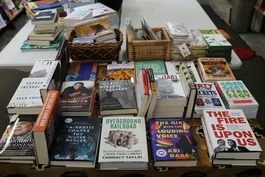
In some ways, it's a continuing trend, but a provocative new cover story in "The Atlantic" puts it far more dramatically, "The Age of Reading Is Over."
It's by Rose Horowitch, a staff writer at "The Atlantic," who joins me now.
And thanks so much for being with us here.
Now, it's a big statement that you're making, so why don't we parse it a little bit?
What do you mean, first of all, by the age of reading?
ROSE HOROWITCH, Staff Writer, "The Atlantic": Yes.
So what I meant by the age of reading was that this is bigger than what the statistics are showing us, that what is really going away is a time when reading was a major way that people transmitted culture, information, news, and really derived meaning from text.
And my piece is arguing that that's ending and that we're entering what I call a post-literate age.
JEFFREY BROWN: And as you remind us at the beginning of this essay, this age of reading, which we have -- many of us have been so immersed in for so long, it actually doesn't have that long a history.
ROSE HOROWITCH: Yes.
Well, so I think we think of reading as kind of something that's innate or inevitable, but actually it's quite historically contingent.
Reading first emerged 6,000 years ago, and it was only relatively recently that large numbers of people could read, and that people spent a lot of time pleasure-reading.
So this is something that is kind of new.
And when this age started, it really transformed society and the way people thought and the way politics and culture worked.
And as it's going away now, I think we're seeing changes of the same magnitude in our society.
JEFFREY BROWN: Now, you refer to what we're entering as a post-literate age.
And there's been plenty of discussion, of course, about social media, short videos on TikTok and elsewhere, and you're arguing that we are reading differently already.
So what do you mean by a post-literate age?
ROSE HOROWITCH: Well, if we look at the statistics, people still know how to read.
The literacy rate is actually historically very high.
And in many ways, we're probably reading more words than ever, if you think about the number of e-mails and text messages and social media posts you're reading.
Like, we're inundated with words and we're surrounded with them.
But what's happening is that this kind of -- these number of words that we're swimming in has made it so that it's almost so difficult to focus on any serious or complex work of literature for an extended period of time.
And so it's not a crisis of literacy.
It's that we are entering a post-literate age.
JEFFREY BROWN: And you write: "Reading shaped the modern mind.
Its disappearance will reshape it."
How will that change things?
ROSE HOROWITCH: The bedrock principle in neuroscience is that you get good at what you practice and your brain adjusts to improve at the things that you spend time doing.
And so if we are spending less time reading, as we know that we are, we are going to struggle much more to do it.
And it's not that we're going to be unable to decode words, but we have much less background knowledge and vocabulary to aid in comprehension.
We are less accustomed to persisting through something for an extended period of time.
And, already, we see that, two decades ago, the average attention span on a screen was 2.5 minutes.
And five years ago, it fell to 47 seconds.
So we're already seeing people kind of being less accustomed to focusing on something.
We're already seeing an erosion of some of our abilities to do complex synthesis and analysis and comprehension.
And we can expect that that would continue.
JEFFREY BROWN: And some of these things, we have been looking at on our program, and of course, have been well-documented elsewhere, just the way this impacts children and the way they learn.
ROSE HOROWITCH: Yes, I think, for me, reporting this piece, sort of the most chilling statistic I found was that only 2 percent of American adults report reading to a child on any given day.
And so I think we see now that this current generation, the current young generation enjoys reading much less and spends less time reading than today's adults did when they were kids.
We know that every year older a child gets, the less they like to read.
In focus groups, high school students described reading for pleasure as an alien practice.
And something else that we know is that schools are assigning fewer and fewer books throughout middle and high school.
In a survey last year, teachers in middle and high school reported assigning between zero and four books a year.
And 80 percent of elementary schoolteachers in a separate survey said that students receive a digital device by the time they enter kindergarten.
So we're seeing that schools are really changing, where they're assigning far fewer books.
And so I think that we can expect that this trend that we're seeing will only accelerate in the years to come.
JEFFREY BROWN: So one thing you write about in the piece is the way that the changes in thinking, the changes in reading impacts who has influence in our culture.
It's gone away from some of the traditional perhaps sources as writers to influencers and others.
Tell us a little bit about that.
ROSE HOROWITCH: You know, in a recent poll, 30 percent -- or 60 percent of Gen Z said that they would be an influencer if they could.
And so I think it's a very different way of culture being passed, of power being in society.
We know that cultural and economic power tends to flow to people who are skilled at using the dominant communications media of the age, and right now that is short-form video, and it's not text.
JEFFREY BROWN: I can't resist at the end of our conversation here pointing out that this death of writing warning comes in a very long and fairly complex essay form.
ROSE HOROWITCH: Yes.
So I write in the piece about my own experience reading and growing up in a family of readers and having books passed down to me from my parents and my older siblings.
And there definitely was an irony in putting this warning about how nobody reads in a 9,000-word essay.
But I wanted to share my experience, because I think that other people can relate to it.
I loved reading when I was a child, and I still love reading today, but I noticed that it almost slipped away from me without me even noticing.
JEFFREY BROWN: All right, Rose Horowitch, thank you very much.
ROSE HOROWITCH: Thank you for having me.
GEOFF BENNETT: For a decade, the National Youth Poet Laureate program has honored some of the country's top young writers who use their words to inspire social change.
Fred de Sam Lazaro recently spoke with its newest laureate in his hometown of Cedar Falls, Iowa.
It's part of our ongoing arts and culture series, Canvas.
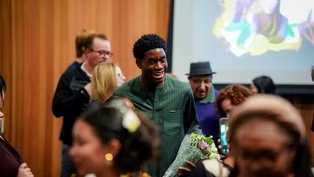
FRED DE SAM LAZARO: As Daniel Umemezie strides through the halls of Cedar Falls High School, he carries with him many titles, homecoming king, two-sport athlete, entrepreneur, and national youth poet laureate.
(CHEERING) FRED DE SAM LAZARO: In April, the 18-year-old was selected from a pool of hundreds of young writers, local poets laureate from sites around the country.
DANIEL UMEMEZIE, National Youth Poet Laureate: I'm still relatively shell-shocked right?
I mean, it's all of that kind of bundled into this emotion of excitement and honor.
FRED DE SAM LAZARO: Umemezie grew up in Nigeria.
He was passionate about art and music from an early age.
DANIEL UMEMEZIE: I played the piano for 14 years.
I played the drums.
I played nine instruments, actually.
So I have done a lot of the arts, drawing, painting, crocheting, knitting.
I mean, I did architecture for a while, so everything.
I have dabbled in it all.
FRED DE SAM LAZARO: And he was an avid reader, regularly scouring the books in the library of his preacher father.
DANIEL UMEMEZIE: I would read the dictionary, because our dictionary had pictures in it.
And I loved to read.
And I loved to find out all the different words, all the different ways you could say a certain thing.
AMARACHI UMEMEZIE, Mother of Daniel Umemezie: He has always been that kind of child that is hungry for knowledge.
Sometimes, you just feel like his mind walks round the clock.
Like, does this mind ever get a break?
FRED DE SAM LAZARO: When Umemezie was 13, his mother got a nursing job in the U.S., so the family, Daniel, his parents, and two siblings moved first to Texas, then to Iowa.
DANIEL UMEMEZIE: The biggest thing I would say I experienced with it was the culture shock.
I mean, you don't say, I'm sorry.
You say my bad.
You don't write with a pen.
You use a pencil to shade in your answers.
It's a bit of a shock when you grow up with a group of people, a group of friends, and you have to move, right?
And then you leave all of that behind to start a new life and to meet new people and grow new connections.
FRED DE SAM LAZARO: Writing and poetry in particular soon became the way Umemezie bridged his two worlds.
DANIEL UMEMEZIE: I come from two Nigerias, a Nigeria where words are rain on zinc tongues and laughter rumbles barefoot down the yellow throat of traffic, its hairy chest bare and clotted with coal.
I come from a language, from a mouth laced with generations, so when I say the words O di mma, it is fine and it will be fine, and I am telling you that it is fine.
I come also from a second Nigeria, one where the generator's chesty cough is the most reliable sound in the neighborhood, one where the madmen cry in the streets and no one knows their names, and no one watches as the street preachers lay hands on potholes, but the madmen still say amen and faith that one day God and the government might share a contractor.
I come from two Nigerias, and they do not wrestle in my ribs.
They take turns breathing, one lung each, which is why some mornings I wake up short of air and do not know which country to ask.
(APPLAUSE) FRED DE SAM LAZARO: Does your mind go to particular themes?
What do you write about?
DANIEL UMEMEZIE: A lot of my writing is based on memory, and memory of place, memory of people, memory of things, memory of objects, memory -- just memories that I don't even have.
Memory doesn't -- is not a one-way street.
You make a memory with someone, the person makes a memory with you.
It's a relationship, right?
And we can explore that with poems.
You can explore that with music.
And it really is a beautiful thing to understand that, once you get to expression, you then find communication a whole lot easier.
And poetry is a way to kind of like toe that line back and forth.
FRED DE SAM LAZARO: Umemezie tries to write at least one poem a day.
His phone is filled with one-liners he jots down any time he gets a new thought, sometimes in the middle of the night.
His notebooks are similarly packed with poems, he's workshopping.
DANIEL UMEMEZIE: In the sun, I am visible through my skin, an ocean of stars see-through, sparsely interstitched into a pool of lucid wax.
I couldn't decide if it was black or wax.
I can taste it in my saliva, freedom in all shapes and colors, like my daddy, feet stumping, tongue twisting-fever in his bones.
And when I'm all grown and grown, I'd like to be a preacher.
FRED DE SAM LAZARO: During his sophomore year, an English teacher encouraged Umemezie to enter a local poetry competition.
He won and went on to become the Cedar Valley youth poet laureate and the Iowa student poet ambassador before winning the national honor this year.
AMANDA GORMAN, Former National Youth Poet Laureate: A country that is bruised but whole.
FRED DE SAM LAZARO: He follows in the footsteps of poets like Amanda Gorman, who was the first national youth poet laureate in 2017, and read her poem "The Hill We Climb" at President Joe Biden's inauguration in 2021.
Umemezie will now travel the country for readings and workshops.
He hopes to champion work that spurs social justice, political participation, and self-exploration.
DANIEL UMEMEZIE: What if silence is not absence, but an actor in this drama, presence with intention, like smoke in a closed room.
I confess I do not understand its purpose.
Some days, it protects me.
Others, it feels like inherited debt.
I remember biting my tongue until it bled, not from fear, but from believing that speech would cost more than silence ever did.
I want a sea change, right, in society where youth are taken seriously.
And then, from that point on, we can find that youth have the confidence to then speak up on matters, whether it be politics, whether it be matters of sexuality, whether it be matters of religion, whether it be matters of war.
And I see poetry as a huge, huge tool for that, because poetry gives you the freedom to say a lot of things.
Poetry gives you the freedom to be free from whatever you might think holds you back.
FRED DE SAM LAZARO: Umemezie graduated from high school in May.
He plans to go to Iowa State University In the fall, not to study creative writing, but -- get this -- aerospace engineering.
Already, he's started a company with three friends developing drone technology to aid in disaster relief.
And he hopes to earn a master's someday at the renowned Iowa Writers' Workshop.
For the "PBS News Hour," this is Fred de Sam Lazaro in Cedar Falls, Iowa.
GEOFF BENNETT: That's the "News Hour" for tonight.
I'm Geoff Bennett.
For all of us here at the "PBS News Hour," thanks for spending part of your evening with us.
 New
NewBlanche questioned on Jan. 6 cases and Epstein files
Video has Closed Captions
Senators question Blanche on Trump loyalty, Jan. 6 cases and Epstein files (5m 19s)
 New
NewDaniel Umemezie on using his words to bridge worlds
Video has Closed Captions
National Youth Poet Laureate Daniel Umemezie on using his words to bridge worlds (6m 32s)
 New
NewLawmakers push to make daylight saving time permanent
Video has Closed Captions
What to know about the latest push to make daylight saving time permanent (5m 27s)
 New
NewNews Wrap: Trump ends pause on ICE traffic stops
Video has Closed Captions
News Wrap: Trump ends pause on ICE traffic stops (5m 57s)
 New
NewPolice cameras help solve crimes, but spark privacy debate
Video has Closed Captions
Police say Flock cameras help solve crimes, but critics call them an invasion of privacy (7m 13s)
 New
NewSubpoenas over NYT report raise press freedom concerns
Video has Closed Captions
Subpoenas over New York Times report on Air Force One raise press freedom concerns (5m 57s)
 New
NewTrump's DNI nominee refuses to say who won 2020 election
Video has Closed Captions
Trump's intelligence nominee refuses to say who won 2020 election (8m 9s)
 New
NewWhy fewer Americans are reading for pleasure
Video has Closed Captions
'Post-literate age': Why fewer Americans are reading for pleasure (7m 47s)
Providing Support for PBS.org
Learn Moreabout PBS online sponsorship
- News and Public Affairs

FRONTLINE is investigative journalism that questions, explains and changes our world.
 New Episode
- News and Public Affairs

Today's top journalists discuss Washington's current political events and public affairs.


 New Episode
 New Episode
 New Episode
 New Episode

Support for PBS provided by:
Major corporate funding for the PBS News Hour is provided by BDO, BNSF, Consumer Cellular, American Cruise Lines, and Raymond James. Funding for the PBS NewsHour Weekend is provided by...