
What Iranians are saying about the war and their government
Clip: 4/9/2026 | 5m 23sVideo has Closed Captions
What people in Iran are saying about the war and their government
In recent days, the focus has been on the fragile U.S.-Iran ceasefire, tensions in the Strait of Hormuz, and Israel’s continued strikes in Lebanon. But less attention has been paid to the people inside Iran, those who have borne the brunt of U.S. and Israeli attacks. For that perspective, Geoff Bennett spoke with Holly Dagres. She spent her teenage years in Tehran and now curates "The Iranist."
Problems playing video? | Closed Captioning Feedback
Problems playing video? | Closed Captioning Feedback
Major corporate funding for the PBS News Hour is provided by BDO, BNSF, Consumer Cellular, American Cruise Lines, and Raymond James. Funding for the PBS NewsHour Weekend is provided by...
What Iranians are saying about the war and their government
Clip: 4/9/2026 | 5m 23sVideo has Closed Captions
In recent days, the focus has been on the fragile U.S.-Iran ceasefire, tensions in the Strait of Hormuz, and Israel’s continued strikes in Lebanon. But less attention has been paid to the people inside Iran, those who have borne the brunt of U.S. and Israeli attacks. For that perspective, Geoff Bennett spoke with Holly Dagres. She spent her teenage years in Tehran and now curates "The Iranist."
Problems playing video? | Closed Captioning Feedback
How to Watch PBS News Hour
PBS News Hour is available to stream on pbs.org and the free PBS App, available on iPhone, Apple TV, Android TV, Android smartphones, Amazon Fire TV, Amazon Fire Tablet, Roku, Samsung Smart TV, and Vizio.
Providing Support for PBS.org
Learn Moreabout PBS online sponsorshipIn recent days, the focus has been on the ceasefire with Iran, tensions in the street of Hormuz, and Israel's continued strikes in Lebanon.
But less attention has been paid to the people inside Iran, those who have borne the brunt of US and Israeli attacks.
What are they thinking about this war and about the regime that governs them?
For that, we turn now to Holly Dog.
She's a senior fellow at the Washington Institute for Near East Policy.
She spent her teenage years in Tehran and now curates the Iranist.
That's a weekly Substack newsletter.
Thanks for being here.
Thank you for having me.
So, what are you hearing?
What has daily life been like for people in Iran, the people that you've been speaking with?
Well, I should note that there's been an internet shutdown for now 41 days.
It was state imposed.
And so, what's petering out of the country is mostly anecdotal.
And what I'm hearing at this juncture is that a lot of Iranians um are confused about what's happening.
Um there was this unprecedented massacre in January and then the president said that help was on the way and then now the ceasefire happens with the regime that they wanted ousted and they're having to live with that.
But then there's also a sense of relief from Iranians that were anti-war to begin with or maybe anti-war over time because they saw all these civilian casualties.
There have been at least 1,700 according to the group Human Rights Activists in Iran.
You mentioned the president's rhetoric, that uh social media post earlier this week where he said, quote, "A whole civilization will die tonight, never to be brought back again.
I don't want that to happen, but it probably will."
How was that interpreted by by people in Iran?
So, it really shook Iranians.
Um the I had Iranian Americans actually reaching out to me and saying, "Is the president going to drop a nuclear weapon on our families in Iran?"
And then we had um the White House actually issue a statement saying that that wasn't going to be a reality.
But going back to my original point, I mean, you're you're saying you want to help the Iranian people and oust the regime and then you're threatening them with getting rid of them as an entire civilization.
And it didn't resonate well at all.
There were um reportedly Iranians fleeing the capital to Iran, stocking up on food, water, electricity.
Some um people were saying that their families were saying goodbye.
We were they weren't necessarily sure that they would have electricity and be able to contact the outside world or if they would even survive what was going to come cuz they were staying up all till 3:30 a.m.
Teron time to see what was going to happen.
So I think it really irked a lot and scared a lot of Iranians across the board.
You mentioned before the war there were Iranians who opposed the regime and welcomed outside pressure.
has the way this war has pro has has progressed so far, has that changed their their point of view?
I would say arguably yes.
Um, again, we we're dealing with the state imposed internet shutdown.
we're not getting the full picture, but from what we're seeing is that just based off what the president's rhetoric was before the war, during the war, and now with the ceasefire, it's not adding up for Iranians.
And I I really um the the big worry now is that yes, um there's this the war may end, but now the Islamic Republic is going to take revenge on the Iranian people.
We've seen at least 1,500 people arrested.
We've seen at least 10 executions.
And some of those were protesters during the January anti-regime uprising.
And so there's a real worry about what's going to be waiting for them because now the Islamic Republic is a rump regime, arguably more hardline, more repressed, and now more emboldened because they've been able to survive this and have control of the straight of Hormuz.
When the president suggests that there are Iranians who want the US strikes to continue, are you hearing that at all or is that a misreading of what people actually want?
Well, you know, I I heard that commentary.
I think that initially at least there were some Iranians that were feeling this way, but the goalposts of the war have changed.
This isn't about the ouster of the Islamic Republic.
It seems like this is about at this juncture degrading its military capabilities and leaving the people in a worse situation than they were originally.
And so, it's hard to say that this is something that the Iranian people asked for.
They've asked for the ouster of the Islamic Republic.
One that now um apparently Vice President JD Vance and a team um are going to be meeting with Islamabad for talks.
So I don't think this is what the Iranian people want.
Understanding that no group is a monolith.
How has this war reshaped how ordinary Iranians view the US and and view Israel?
You know, I you know, for a long time I I've said for that Iranians were arguably the more most pro-American in the Middle East, if not the world.
And I'm not entirely sure how they're going to feel after this war.
Um assuming that the ceasefire holds because of what has happened over the past few weeks.
But I think that there's also a reality that Iranians know how to separate the government of the United States from the American people.
and they've always said that and so I think that we can't put a think one sort of thinking for Iranians especially anti-regime Iranians.
Holly Dress, thanks as always for your insights.
Thank you.
Support journalism you trust.
Support PBS News.
Donate now or even better start a monthly contribution today.
 New
NewAnthropic’s new AI model raises fears about high-tech risks
Video has Closed Captions
Anthropic’s powerful new AI model raises concerns about high-tech risks (6m 19s)
 New
NewInside Chicago's Steppenwolf Theatre as it marks 50 years
Video has Closed Captions
Inside Chicago's innovative Steppenwolf Theatre Company as it marks 50 years (6m 39s)
 New
NewIsraelis mark Passover in shadow of war
Video has Closed Captions
Israelis mark Passover in shadow of war: 'We cannot celebrate together' (5m 10s)
 New
NewIsrael, Lebanon to talk as strikes threaten U.S.-Iran truce
Video has Closed Captions
Israel agrees to talks with Lebanon as strikes there threaten fragile U.S.-Iran truce (6m 58s)
 New
NewMelania Trump denies close relationship with Epstein
Video has Closed Captions
In rare public address, Melania Trump denies close relationship with Epstein (2m 31s)
 New
NewNews Wrap: NASA optimistic ahead of Artemis II reentry
Video has Closed Captions
News Wrap: NASA optimistic ahead of Artemis II reentry (5m 28s)
 New
NewTrump’s Iran rhetoric faces scrutiny as Congress returns
Video has Closed Captions
Trump’s Iran strategy and rhetoric face scrutiny as Congress returns from recess (5m)
 New
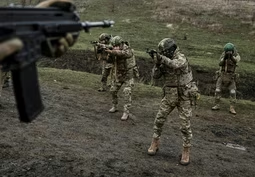
NewUkraine faces military desertions as Russian war grinds on
Video has Closed Captions
Ukraine faces military desertions as Russian invasion grinds through 5th year (8m 41s)
Providing Support for PBS.org
Learn Moreabout PBS online sponsorship
- News and Public Affairs

FRONTLINE is investigative journalism that questions, explains and changes our world.

- News and Public Affairs

Today's top journalists discuss Washington's current political events and public affairs.











Support for PBS provided by:
Major corporate funding for the PBS News Hour is provided by BDO, BNSF, Consumer Cellular, American Cruise Lines, and Raymond James. Funding for the PBS NewsHour Weekend is provided by...