Here and Now
Here & Now for March 20, 2026
Season 2400 Episode 2436 | 26m 47sVideo has Closed Captions
Watch the entire episode of Here & Now for March 20.
Watch the entire episode of Here & Now for March 20.
Problems playing video? | Closed Captioning Feedback
Problems playing video? | Closed Captioning Feedback
Here and Now is a local public television program presented by PBS Wisconsin
Here and Now
Here & Now for March 20, 2026
Season 2400 Episode 2436 | 26m 47sVideo has Closed Captions
Watch the entire episode of Here & Now for March 20.
Problems playing video? | Closed Captioning Feedback
How to Watch Here and Now
Here and Now is available to stream on pbs.org and the free PBS App, available on iPhone, Apple TV, Android TV, Android smartphones, Amazon Fire TV, Amazon Fire Tablet, Roku, Samsung Smart TV, and Vizio.
Providing Support for PBS.org
Learn Moreabout PBS online sponsorship>> The following program is a PBS Wisconsin Original Production.
>> Snowfall breaks records across Wisconsin as political gridlock breaks, with passage of bipartisan bills in the final regular session of the state Senate.
[MUSIC] I'm Frederica Freyberg tonight on "Here& Now", price shocks for fuel and fertilizer have Wisconsin farmers planning ahead.
We hear from state Supreme Court candidates on the issue of abortion.
And primary candidates for governor also offer their positions.
State public defenders sound the alarm on staff shortages.
And we take a look at our new podcast, Inside Wisconsin Politics.
[MUSIC] 20th.
>> Funding for Here and Now is provided by the Focus Fund for Journalism and Friends of PBS Wisconsin.
>> Fuel and Fertilizer.
The cost of them has spiked due to the war in Iran that has disrupted crude oil fields and transport, as well as the export of fertilizer on farms.
In Wisconsin, growers consider their crops and spring planting in the face of this price volatility.
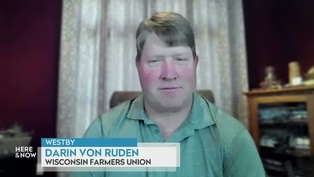
Wisconsin Farmers Union President Darin Von Ruden is here with more.
He joins us from Westby.
And thanks a lot for being here.
>> Thanks for having me this morning.
>> So what are your farmer members saying about the price shocks happening right now?
>> Well, lots of concerns.
You know, some of our members actually were able to book their inputs last fall, so probably aren't going to see that sticker shock this spring.
Like we are amongst other members that don't have the ability to because of cash flow problems by that.
So they're right now probably examining, do we stay with corn and need to put more nitrogen on the ground, or should we look at a, you know, small grain crop or do we plant more soybeans just because of that price of fertilizers has increased so much in the last two weeks here.
>> What are the ways the increased cost of fuel impact producers?
>> Well, in really in all aspects, number one, it costs more to get the, the items that we need to produce the crops to the farm.
There are surcharges that are co-ops in process or our delivery folks will be charging.
It's going to cost more to put the crop in the ground.
If.
Unless you were able to book that fuel earlier, which doesn't happen very often.
And then just to get the products that we produce to the consumer through the processors and distributors, we're probably going to be seeing surcharges on those deliveries to.
>> Now.
The Trump administration just waved a 100 year old shipping law to speed up oil and fertilizer shipments ahead of spring planting.
How welcome is that?
>> Well, you know, if it helps in that price of what the cost is to get by that gallon of diesel or that gallon of gas, you know, it certainly is welcome news, but I'm hearing that it's it probably will have very little impact on it because, you know, planting season is probably two weeks away in southern Wisconsin here right now.
So can that really impact what's going to happen on day one when farmers need to be in the fields?
Big question mark there.
>> Yeah for sure.
So how how difficult is it to move from corn to soybeans or other crops?
Just kind of on a dime here.
>> The biggest thing is, is the availability of the seeds.
So, you know, farmers generally try to have that contracted earlier delivery.
You know, at this time of year, those seeds are being delivered to the farm.
So if your supplier has adequate supplies of both, you're in good shape.
But some years they'll the people that we buy from are trying to guess what farmers are going to do.
And so could be shorted one or the other.
And small grains is another issue because a lot of suppliers don't necessarily have large quantities of that seed available.
So it might take 2 to 3 weeks to get that to come in from another source.
>> So even ahead of the war in Iran, how have Wisconsin farmers weathered tariffs and resulting markets?
>> Yeah, certainly, you know, last year was not a good year for farmers on the on the economic side, a lot of farmers posted losses in corn and soybeans, especially because of that disruption in the marketplace and not having those overseas buyers to buy that.
You know, we have weather, a little bit of that with the increased prices that we've seen.
After President Trump announced some of the trade deals with China, but we still haven't seen all of those markets come back to the level that they were two, three years ago.
>> How meaningful have one time payments out of Washington to offset tariff losses been for farmers in Wisconsin?
>> Well, you know, it certainly has helped ease some of the pain between the banker and the farmer because they were able to pay maybe a bigger portion of the the operating loan that they had.
But in reality, when you look at the the real numbers, it was only about 15% of what farmers needed to pay for their production costs.
So, you know, in the end, we're still quite a bit behind on that process.
And, you know, farmers generally want to receive our income from the marketplace and not depend on Uncle Sam to send us a check when we're in dire needs.
And so with the trade war that we had, you know, those market conditions were really impacted in a negative way.
And it's really a frustration of farmers that we need to depend on the federal monies to come in in order to pay bills.
>> All right.
Darin Von Ruden, thanks for explaining all this to us.
>> Thank you.
Fredricka.
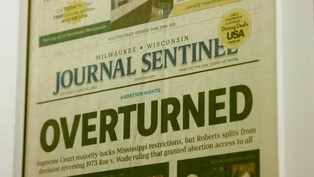
>> Just last year, the Wisconsin Supreme Court overturned the state's 1849 abortion ban, the 4 to 3 decision by the Liberal majority settled the legal question of which state statute governs abortion.
But that doesn't mean the topic won't be a big factor in the ad campaign.
In this spring's race for a seat on the Supreme Court, that race is between conservative Judge Maria Lazar and Liberal Judge Chris Taylor "Here& Now".
Senior political reporter Zac Schultz sat down with the candidates and has the story.
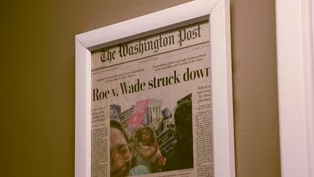
>> In 2022, the United States Supreme Court scrambled the political world with the Dobbs decision overturning Roe versus Wade and returning the issue of abortion to the states.
In Wisconsin, that meant an 1849 abortion ban went back into effect.
>> As we fight to protect and now restore reproductive freedom in Wisconsin.
>> The Democratic Attorney general, Josh Kaul, filed a.
>> Lawsuit saying a more recent abortion law passed by Republicans when Roe was still in effect, nullified the 1849 ban.
The court agreed with the Liberal majority deciding the case by one vote.
This election will fill the seat of the retiring conservative Justice Rebecca Bradley.
So if Judge Taylor or Judge Lazar had been on that case, it wouldn't have changed the outcome.
But we wanted to know if they agreed with the court's decision.
>> So I agree with the decision that the 1849 law should not be implemented based on laws that had been passed since then that directly conflict with it.
I think that that was the right decision by the majority on the state Supreme Court.
Again, it was by one vote.
This really contrasts with my opponent.
My opponent would have voted to implement an 1849 abortion ban that was passed when I couldn't vote and many people couldn't vote.
So I think it was really the right decision by our state Supreme Court.
And that's a big point of difference between myself and my opponent.
>> I'm not going to say how it would rule, but I will say what I will do moving forward, and I have put that in positions.
I've released a statement, I've released an op ed talking about abortion and indicating that this is a really complicated issue for the woman, and her life is so valuable and important.
And I've indicated that 1 I respect the rule as decided by the state Supreme Court.
I will only be one of three members in the majority in the minority, so I won't be changing that.
And two, I think women in the state need clarity.
They need certainty.
And three, you need to lower the temperature on this issue.
This is resolved as far as I'm concerned, for courts, for the judiciary.
The legislature can do what they want, and the people in the state of Wisconsin can do what they want.
But the judiciary, it's clear it's done.
>> Reporting from Madison.
I'm Zac Schultz for "Here& Now".
>> While the Wisconsin Supreme Court has settled the issue of state law surrounding abortion, the medical procedure is not a constitutionally protected right in Wisconsin.
So the next legislature and governor could change the law at any time.
As part of our continuing series examining the big issues in the governor's election, Zac Schultz asked the leading candidates about the topic of abortion.
>> My choice.
>> In the nearly four years since the Dobbs decision has returned the issue of abortion to the states, Wisconsin's Republican controlled legislature and Democratic Governor Tony Evers were not able to agree on any laws regarding abortion, whether that was time limits, exceptions for rape and incest, or medical definitions for when the life of the mother was in danger.
We asked the leading candidates for governor if they would like to see any changes to Wisconsin's abortion laws.
>> Yes, and I've authored many of them.
I believe that abortion and frankly, all health care decisions are personal and individual politicians have no role in making those decisions for you.
And certainly we cannot allow abortion, contraception, IVF to be criminalized or put doctors under threat when they're simply providing care.
I want to see your freedom to make your own decisions guaranteed in this state.
>> Look, I'm a huge champion when it comes down to to abortion here in the state of Wisconsin.
When I was a state representative in 2017, I coauthored legislation declaring abortion as health care and as a as a father of three daughters.
Being a girl dad times three is important for me to make sure that they have the same rights that their mother and grandmother had, not less.
And so I'm going to always be a champion for women's rights to choose.
>> No.
So I voted for the current law, which ten years ago when I was in the state legislature, which is you can have an abortion up to five months.
And I voted for that law.
And as governor, I will uphold it.
>> Well, abortion to me is a decision that is best made between a woman and her health care provider.
Abortion is health care.
And so, you know, I'd like to see us to do things that get politics out of that and ensure that that women and their doctors can make those decisions, educated and informed decisions on their own.
>> What we need to do is to make sure that we enshrine Roe within Wisconsin.
That's what I've always been really clear about.
I'm, again, a nurse by background.
We know that these type of healthcare decisions are best made between a patient and their doctor, and Roe has been something that has kept women safe for decades.
And we need to make sure that we have legislation to keep women safe in Wisconsin so that it does not go back and forth between if we have different leaders between Republicans and Democrats.
1849 abortion ban.
And I think abortion freedom and is, you know, about health care and democracy as well.
And so I think it's important that we keep in mind that abortion is health care, and that access to that health care has to be equitable.
>> And I would love to see this country get back to a pre Dobbs era, because Roe was the law of the land that was generally accepted by Democrats, of course, but even Republicans who didn't necessarily like abortion wasn't their thing.
Roe was sort of a compromise for them and something they felt comfortable with.
>> I would like to see it proactively protected.
Women's right to choose right now is dependent on court cases, and we need to have a law on the on the books that protects women's right to choose, protects women's rights, to take care of everything that they need for their bodies and puts women first in that conversation.
>> Reporting from Madison.
I'm Zac Schultz for "Here& Now".
>> Our attorneys are drowning.
That's a quote from the Wisconsin state public defender.
After the state Senate adjourned without taking up a bill to fund 52 new positions, including 18 additional attorneys, the agency says a staff shortage leaves defendants waiting for representation and a backlog of cases in the courts.
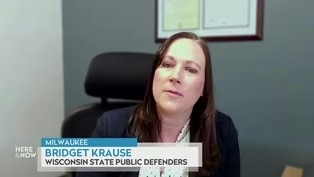
Here to talk about it, deputy State Public Defender Bridget Krause, and thanks very much for being here.
>> Good morning.
Thanks for having me.
>> So how has the shortage of support staff and attorneys grown?
>> It's grown tremendously over the last few years, especially since the pandemic.
Not only have we been short with the number of private bar lawyers that are taking cases in the state of Wisconsin, we've also had an increase in the number of cases coming in, but we have not had an increase in the number of public defenders or public defender's support staff added to the SPD.
So it has been growth over a number of years.
And I think after the pandemic, we finally saw how it was affecting both the legal system as well as the attorneys and the clients that are represented by the public defender's office.
>> What are the consequences of not having enough people to timely defend everyone who needs it?
>> People waiting in custody longer, right cases go longer without having a lawyer.
So we have had clients sitting in custody prior to a preliminary hearing, which they're entitled to have within ten days if they're in custody, 20 days if they're out of custody and they're sitting there without a lawyer because there's no lawyer to take their case, you also have cases in the system longer, right?
So cases that might have resolved 66 months to nine months pre-pandemic now are waiting longer to resolve or longer to even get an attorney.
So there's a lot of delay in both getting a client, a lawyer, and there's a lot of delay in resolving a case which could have an impact on both the system as well as the individuals who, you know, the complaining witnesses in a case, the people that have gone to the police for help, it delays the case for them.
Also.
>> What are the frustrations like inside the courtroom, inside the criminal justice system?
>> I think the judges are frustrated, right?
They're frustrated.
>> Because there's no lawyer sitting with the client at very important stages, including a preliminary hearing as the case moves forward.
Right.
It's hard to get a lawyer to sit with that client if there's no lawyers available.
There's a lot of frustration by public defenders.
Honestly, we want to represent our clients.
We don't want people sitting in custody without a lawyer, right?
We don't want people sitting there that could be innocent of the crimes that they've been accused of, because they don't have a lawyer to represent them.
I think it's frustrating for prosecutors, too, honestly, because they have charged specific cases and someone doesn't have a lawyer.
Therefore, that case cannot move forward.
So I think there's a lot of frustration in the system.
It's probably frustrating also, honestly, for the sheriff's office that run the jails, because if you can't get a lawyer for a client, that client might sit in custody and then you have more people in custody than should be in custody and the jails can't handle it.
new prosecutor positions.
How does that exacerbate case delays?
>> I mean, there's only so many.
>> Lawyers to take the cases that are coming in.
And when you add prosecutors, you add the number of cases coming into the system.
So if you're adding prosecutors on one side, they're reviewing charges, they're charging cases.
But if you don't have the lawyers on the other side to represent those clients, it just bottlenecks the system.
So any progress that we make in bringing in new lawyers, new private bar lawyers to take the cases, any progress we make in filling vacancies in the state public defender's really go nowhere because of the increase in the number of cases coming into the system.
>> So you spoke to private bar attorneys who can be appointed, and are they at all helping to offset this shortage?
>> I think they're helping as much as they can.
Right?
They also only have so much bandwidth.
So they can also only take so many cases.
We have some really great private bar partners who take cases for us.
Right.
And they've taken cases for us for years.
But at some point they are also saturated with representing clients.
And it's not just a warm body next to a client, right?
A client has a right to effective ethical representation.
And if you have too many cases, you can't provide that to a client.
So I think our private bar partners are working really hard to help us.
But again, you only have so many lawyers.
And if you continue to bring the cases in, you just don't have enough lawyers to handle those cases.
>> Now, your agency calls this an unfunded mandate.
What's the mandate?
>> I think the mandate is, you know, Gideon, the anniversary of Gideon was just this past Wednesday.
And Gideon, the US Supreme Court said that clients have a constitutional right to have a lawyer represent them.
That's the mandate.
When you don't have lawyers checking the prosecution, checking the police department, it causes a tremendous it causes an effect across the state, across our counties, across our cities, because people are unchecked and they're able to prosecute people or charge people with very serious cases.
And if you don't have a lawyer sitting next to that client, it affects the entire community.
So we have an obligation, an obligation in our state to provide lawyers for people that are charged with crimes.
There is a there is a constitutional protecting.
Those clients have to be proven guilty beyond a reasonable doubt.
But you need a lawyer sitting next to that client providing that defense, reviewing that discovery, providing that advice to clients and fighting in court if necessary.
And when you don't have that, the entire system fails.
>> We leave it there.
Bridgette Krause, thanks very much.
>> Thank you.
>> The state Senate adjourned this week, but not before passing bipartisan bills to release more than $125 million for PFAs cleanup protections and help for communities poisoned by the forever chemical.
After years of impasse, the measures now head to the governor for signing in.
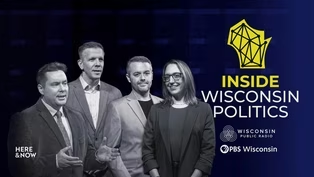
Related news, tonight we share a new on air program and podcast from W, r and PBS Wisconsin News.
Inside Wisconsin Politics is a weekly political roundtable that brings together our most experienced Capitol reporters to share the week's political and government news, explaining what happened, what it means and why it matters.
PBS Wisconsin senior political reporter Zac Schultz w p r Capitol Bureau Chief Shawn Johnson and w r political reporters Rich Kramer and Anna Van Wagtendonk joined The conversation.
Today's program included the breaking news that the Republican state Senate majority leader will not run for reelection.
The crew unpacked whether the governor will sign the online sports betting bill passed out of the chamber, the approval of money for the UW to offset name, image and likeness costs of athletes and data centers, and how the politics of the final regular Senate session played into it all.
Here's an excerpt.
>> The Wisconsin Senate wraps up its regular business for 2026.
What passed, what didn't, and what can we learn from the way this Senate voted?
This is inside Wisconsin politics.
The Senate gave us lots to talk about, including as we're getting ready to record news that the Senate majority leader, Devin LeMahiue, is not going to seek reelection, which in the world of the state Capitol, as you all know, that is a pretty big deal.
Zac, what can we take from that, given the way that the Senate has been acting this week?
And how big a deal is it in the Capitol?
>> Well, it certainly felt like a week of voting where people weren't worried the next term.
There were questions of whether that signaled LeMahiue knew that his majority position was at stake.
As Republicans are worried about having the Dems flip the Senate.
But I think the bigger picture to look here is we're going to have a new majority leader in the Senate, a new speaker in the Assembly and a new governor.
And the last time that happened was 2011 with Scott Walker and the Fitz's running the show.
Big changes that time.
We might see big changes next session, too.
>> A wave election.
And there's people, of course, every every election is nationalized right now.
And there have already been people talking about nationalized democratic you know, that Capitol building and you know how much sway leaders carry, how big of a deal is it to you that Devin LeMahiue, the leader that you've covered in that Senate since you've been here is stepping down?
that came forward where there was a real question of whether Devin would let them get to the floor, because he did not have Republican votes.
And so there were kind of threats being floated about what that would mean for his leadership position.
And those bills passed with necessary Democratic votes in order to pass.
And so then him stepping down, it really is this kind of signal that he whatever kind of consequences might have come in the caucus, he doesn't have to worry about them anymore.
>> And Rich, you were covering the session this week and that question of whether or not to get Democratic votes is talking about.
And, you know, the Senate Senator LeMahiue even had some kind of not so veiled threats thrown out from a member of his own caucus.
Don't do that.
Basically, how unusual was this session week in terms of bipartisanship?
Frankly.
>> Things are changing there.
It feels like things are changing in the Senate.
They used to have a supermajority not that long ago.
Then we got new maps after the Wisconsin Supreme Court's Liberal majority struck down ones that were drawn by Republicans back in 2011.
And then we had an election under those maps.
So that supermajority went down to 18 Republican senators.
And that threat goes to this thing called the the rule of 17.
It's an informal rule, but the idea is that if you're in the majority, you pass bills with majority support.
You don't even really consider them if you don't have those 17 votes.
But we saw examples where Devin LeMahiue went ahead and passed them anyway with Democratic support.
>> So let's unpack a couple of the bills where this did end up being a factor this week.
And one of the bills that did die was this Republican data center bill would regulate data centers.
Speaker Vos very helpfully had a forum on the last day of Senate session where he had some opinions about the Senate not taking up his data center bill.
Ana what did he have to say?
>> Yeah, I mean, this was basically the closest that the legislature came to having any type of regulatory bill for data centers, which of course, are kind of exploding across the state.
And the fact that it is that it did not reach the floor of the Senate means that the session has passed without basically any guardrails, any new guardrails coming on.
But this was a Republican bill Vos championed it.
It had a few Democratic votes in the Assembly, but most Democrats said this is rushed.
We need to be more thoughtful about how we are regulating data centers.
And then the Senate didn't even bring it to the floor.
But Vos talked about, you know, that really being as he thought, an issue for Senate Republicans, that if they don't kind of lead on this issue, that it might cost them votes in November.
>> Yeah.
It's rare to hear a speaker come out against a majority leader from his own party the week that he's still in session with that kind of criticism.
I think sort of the secret was sort of out on Tuesday.
I mean, we didn't know know that Devin LeMahiue was not going to seek reelection, but there was talk about it.
There was speculation about it.
People are looking at the Senate math and they're thinking about it.
>> Well, it changes a lot when no one has to worry about reelection next year.
And Serve Wisconsin LeMahiue can all speak in ways that we have not heard or we have not heard them speak publicly.
We've heard them off the record or heard from their staffers.
But I think this bill in particular still has the next election cycle written all over it, as Vos pointed out, because it's a major issue in the gubernatorial campaign.
I think if LeMahiue had a strong point of view, he would have brought up the floor and let Democrats help pass it if he thought that was the way to go.
But there's not a clear advantage at this time.
And Tom, Tiffany as governor is clearly as well.
So this is definitely one for the fall.
>> You can find the full Inside Wisconsin politics at PBS Wisconsin.
Org dot, YouTube or wherever you get your podcasts.
Visit our website at PBS.
Org and then click on the news tab.
That's our program for tonight.
I'm Frederica Freyberg.
Have a good weekend.
>> Funding for here and Now is provided by the fund for is provided by the fund for Journalism and Friends of PBS Wisconsin.
 New
NewAbortion Laws and Wisconsin's 2026 Candidates for Governor
Video has Closed Captions
Clip: S2400 Ep2436 | 4m 1s | Candidates in the 2026 race for governor on how the state regulates abortion. (4m 1s)
 New
NewBridget Krause on Wisconsin's Public Defender Staff Shortage
Video has Closed Captions
Clip: S2400 Ep2436 | 6m 11s | Bridget Krause on the public defender's office staff shortage and a criminal case backlog. (6m 11s)
 New
NewDarin Von Ruden on Fuel and Fertilizer Price Shocks to Farm
Video has Closed Captions
Clip: S2400 Ep2436 | 5m 15s | Darin Von Ruden on rising prices of fuel and fertilizer are affecting the planting season. (5m 15s)
 New
NewHere & Now opening for March 20, 2026
Video has Closed Captions
Clip: S2400 Ep2436 | 1m 6s | The introduction to the March 20, 2026 episode of Here & Now. (1m 6s)
 New
NewInside Wisconsin Politics: The State Senate Looks Past 2026
Video has Closed Captions
Clip: S2400 Ep2436 | 6m 28s | Inside Wisconsin Politics on the state Senate wrapping up its 2026 session. (6m 28s)
 New
NewMaria Lazar, Chris Taylor on Wisconsin's Abortion Ban Ruling
Video has Closed Captions
Clip: S2400 Ep2436 | 3m 4s | Maria Lazar and Chris Taylor on the 4-3 decision to overturn a law that banned abortions. (3m 4s)
Providing Support for PBS.org
Learn Moreabout PBS online sponsorship
- News and Public Affairs

Top journalists deliver compelling original analysis of the hour's headlines.

- News and Public Affairs

FRONTLINE is investigative journalism that questions, explains and changes our world.











Support for PBS provided by:
Here and Now is a local public television program presented by PBS Wisconsin