
What role does China play in resolving the Iran war?
Clip: 5/15/2026 | 13m 27sVideo has Closed Captions
What role does China play in resolving the Iran war?
On his way back from China, President Trump told reporters, “We’ve settled a lot of different problems that other people wouldn’t have been able to settle.” But China’s support for Iran and American support for Taiwan are two things that weren't settled
Problems playing video? | Closed Captioning Feedback
Problems playing video? | Closed Captioning Feedback
Major funding for “Washington Week with The Atlantic” is provided by Consumer Cellular, Otsuka, Kaiser Permanente, the Yuen Foundation, and the Corporation for Public Broadcasting.
What role does China play in resolving the Iran war?
Clip: 5/15/2026 | 13m 27sVideo has Closed Captions
On his way back from China, President Trump told reporters, “We’ve settled a lot of different problems that other people wouldn’t have been able to settle.” But China’s support for Iran and American support for Taiwan are two things that weren't settled
Problems playing video? | Closed Captioning Feedback
Where to Watch Washington Week with The Atlantic
Washington Week with The Atlantic is available to stream on pbs.org and the PBS app.
Buy Now
10 big stories Washington Week covered
Washington Week came on the air February 23, 1967. In the 50 years that followed, we covered a lot of history-making events. Read up on 10 of the biggest stories Washington Week covered in its first 50 years.Providing Support for PBS.org
Learn Moreabout PBS online sponsorshipHow important is China to solving the Iran mess, for lack of a better word?
I mean, I think the problem is Iran is important to solving the Iran mess, right?
We've talked about this now week after week, but what the president is in a box.
He needs to find a way to get out of it domestically in order to to shore up his his his Republicans who are facing a a pretty tough midterm year.
And yet, he can't stop the war in a real way uh without something he call victory.
And the Iranians aren't going to give it to him.
They made very clear they feel like they can wait him out at this point.
They do not feel like they have lost this war.
They feel like uh that the time is on their side and they're not going to simply say, "Yes, you're right.
We're going to up all of our nuclear program just because you want us to."
Right.
Can I Nancy, I want to talk to you about where exactly we are in the uh the level of crippling of Iran's capabilities.
But I have an even bigger question for the table for just something that popped to mind.
Uh, China is supplying Iran with weapons to fight America.
Iran has been in the past fighting supplying drones to Russia to fight in Ukraine, a Ukraine that's supplied by Europe and America and so on.
There's this cascade.
Are we in World War II, but we just don't know it?
Susan, you know, it's this is an essay question.
you get 50% of your grade comes from this answer.
Well, uh I'm I you know it's one of those moments in history.
I actually wrote a column based on a conversation with Fiona Hill, the Russia expert in September of 2022, Jeeoff, in which she and I were talking about this very question and I wrote that she said it was quite possible we were already in World War II.
There was kind of a huge amount of freakout at that moment in time.
that what she was suggesting is what you're suggesting right now which is that the adversary alignment between Russia, Iran, China suggests a sort of you know call it an informal certainly not a formalized axis uh aligning itself.
It's what Joe Biden you know we don't talk about him anymore but you know what Joe Biden used to talk about sort of the the inflection point the confrontation between democracies and autocracies.
The difference here, Jeeoff, and that's why I underscored how how radical Trump's rhetoric was in Beijing this week.
The difference here is that it is not clear at the moment what side the United States of America is on.
And I think it's very important to underscore that that the difference from September of 2022 when this this question of World War II was already out there in in in the ether is that the United States's own role in shoring up our democratic partners in the Middle East and in Asia and in Europe is no longer certain.
Maybe that's why it's not quite World War II in the sense that it might be closer to World War II if America knew what side it was on and was more vigorous in confronting this axis of fill in the blank.
I'm not going to hark back 20 years, but you know what I'm thinking.
Uh but we don't we don't know what the president thinks about this.
Well, we also don't know what America after Trump is going to be like.
I mean, you know, the United States wavered before entering uh World War II.
uh and we sort of wrote the history of that America first movement, you know, out of our collective memory, I think, because of, you know, the momentous events that followed.
And so we don't know what follows Donald Trump.
I think the question is, were so many Republicans and Democrats wrong when they spent the last 10 years telling us that a major strategic competition with China, including military, economic, all domains that were were they all wrong or is that still going to be the case?
Right, Nancy?
The Iran war itself, uh, obviously the Trump administration believes that it has won the Iran war.
Um, Sentcom, the military, has more nuanced view of the various levels of degradation of Iranian uh, armaments and defensive and offensive capabilities.
But give us your global assessment of where we are right now.
I mean, very simply, there are not any good military options on the table to resolve this conflict.
something like an an aggressive restarting of military strikes on Iran doesn't guarantee a win because you could see Iran still carry out um strikes on allies on US interests.
A limited strike, a love tap if you were isn't necessarily going to lead to a different outcome.
Um waiting this out and just having a pro protracted stalemate isn't an option because of the impact on the world economic market.
So your the best outcome on the table right now is some sort of deal on the straight of Hormuz and dealing with other issues later.
But as Peter noted, the Iranians don't have an incentive to reach that deal at this point.
According to the US intelligence community, they believe that they can hold out and and and and suffer the blockade that the United States is putting in for several more months all the way up until the midterms, which means in some ways they have checkmated the United States in terms of the timeline with which u a deal can be reached.
Does does the US have theoretically the capability of taking Iran going all the way troops, the use of troops, the use of weapon systems that we haven't used yet, or is that just not being discussed because there's no possible way that President Trump is going to deploy ground troops to create conditions for regime change?
So, ground troops don't guarantee a victorious outcome either.
And so I think what's missing in this is tying those military tactics to a clear strategic outcome.
More force, more troops, more attacks in and of itself doesn't guarantee it.
Now, does the US have the capability?
It certainly does, but um it comes with risk.
It takes it um it's a draining of resources.
It is costly and politically it's risky because I don't think there's an appetite for it particularly if the outcome leads to an extended conflict one in which not only the US but the world economy finds itself uh in a strangle hold because of the ongoing um um hostilities and so that's why negotiations becomes the the the most palatable option but how you reach that deal and how much you have to concede to Iran and its hold on the straight going forward is what makes it so complicated.
So before the war, there was no Iranian hold on the street.
Now there is and that's what's upsetting President Trump when he's confronted with the idea that he hasn't won.
Is that fair?
Yes.
Because that was their nuclear option taking the straight of Hormuz.
Remember when the United States assassinated Kasamsulammani, the former IRGC leader in 2020, they did not retaliate with this way.
I think one of the lessons that they've learned is that the way we do deterrence going forward, the way we prevent the United States, the Iranians, that's right, is that we we hold this we hold economic leverage over the world economy that that the practices of the past did were not a successful form of deterrence, which means they're not going to easily give up the their control over the street because to them it's essential now to their security.
Trump just had Yeah.
Yeah.
Trump just had a pretty remarkable exchange with uh your colleague David Sanger on Air Force One on this subject.
I want you to watch this.
What are the used of repeating the bombing?
You you did it for 38 days.
No, we did.
And you did not get the political changes in Iran.
No, I got I I had a total military victory, but the fake news guys like you right incorrectly.
You're a fake guy.
I actually think it's sort of treasonous what you're right.
But you and the New York Times and CNN I would say are the worst.
On another wall, you should know better, D. Your editors tell you what to write and you're right and you should be ashamed of this another I actually think it's treason.
I want to make a small point and a big point.
Yeah.
First, his editors don't tell him what to write.
They were very surprised to hear that today.
they would like it, but they they the larger point I I want to make and and please jump in on this is that it's absolutely outrageous for Donald Trump to call David Sanger or any reporter treasonous.
That's the worst thing you could accuse a a person uh of of being.
He's a professional reporter and he's a patriotic American.
We all know him.
Um and he's not obviously the first reporter to be attacked by President Trump even this week.
The what one of the things that makes that encounter unusual is that he used the word treason.
The other is that David Sanger is not a black female reporter, which is Trump's sometimes preferred uh target.
Um but but on the the exact subject that we were talking about, this obviously triggered him in some terrible way.
Well, look, he in his second term has been much more willing to go further even than he did in his first term in terms of the idea that anybody who questions him, who says something he doesn't like, who uh reports something he doesn't either accept or want to believe or doesn't knows is true but doesn't want anybody else to believe is now not just a a bad reporter, not somebody who's a critic or the opposition, but treasonous.
He is now using that term treason and the other term sedition with increasing frequency in the last few months.
He used it about our coverage, for instance, about his health.
It's it's treasonous or sedicious to even ask questions about his health.
He said he used that now against politicians as well.
Obviously, he accused six members.
I think that was known in behind the iron curtain as the Chaoescu rule.
Exactly.
Exactly.
Remember, six members of Congress who who dared to write uh film a video saying to the military, "Do not follow illegal orders were then not just called uh traitors, but actually uh the Trump administration tried to bring charges against them, criminal charges against them.
So I think what we're seeing is a real escalation in this second term about uh going after people who they consider to be uh enemies and that they consider to be uh providing information that they don't want to be out there or views to be uh squaltched.
Yeah.
Can I just note um article 3 section 3 was written very narrowly because the founding fathers watch British monarchies make accusations of treason against their critics and the conduct of their um their their monarchies.
And so it's this was written precisely to not be used in this way.
If you read Hamilton's Federalist 84, he he talks about this that it ha is such a high charge that it has to meet the definition of helping enemies during war.
And that was written in the spirit of making sure that that critics um that the First Amendment and the the press's right and responsibility to critique was protected and wasn't um abused in such a way that that that reporters would be or critics would be called treasonous for for pointing out um um valid criticisms.
I want you all to watch one more quick clip of Donald Trump talking on these general subjects.
Um, this happened, this took place immediately after he was asked how uh Americans financial health might be uh affected by the Iran war.
Not even a little bit.
It the only thing that matters when I'm talking about Iran, they can't have a nuclear weapon.
I don't think about Americans financial situation.
I don't think about anybody.
I think about one thing.
We cannot let Iran have a nuclear weapon.
That's all.
go democratic democratic democratic ad makers are going to have fun with that.
He was trying to threaten Iran in a kind of way saying nothing's going to deter me, but that came out in a way that I'm sure people on his team were like that's not going to help.
Yeah, I'm I mean I'm not one to try to interpret what the president uh says or what he meant to say.
Um, obviously I think in a charitable way you could say he was singularly determined to say this is a national security threat and this is the reason we went to this went to war and I realize there's economic pain but this is worth it right didn't come out that way right and as you said for political reasons right the the opposition the democrats are will have a field day because it cuts to the very issue with this war which is unpopular and is causing a lot of economic pain right Peter last 30 seconds.
Uh it's very very hard if you're an adversary of the United States to understand how serious Trump is about preventing Iran from getting a nuclear weapon for one thing or defending Taiwan, South Korea, another.
Uh where does that leave uh where does that leave our credibility?
Where does that leave American credibility?
Well, this is the problem, right?
So presidents have over the years, Republicans and Democrats, insisted on or tried to to to maintain a certain discipline, a certain consistency in order to avoid misunderstandings because misunderstandings in some ways is the most dangerous factor in international relations.
Misjudgments, misunder miscalculations about what somebody might do in X or Y situation.
And I think in some ways you could see how that plays out in Iran right now in terms of the miscalculations on both sides.
Well, it's fascinating conversation, but we are going to have to leave it there.
I want to thank our guests for joining me and thank you at home for watching us.
For more on how Trump's unpredictability may be making the US an unreliable ally, please visit theatlantic.com.
I'm Jeffrey Goldberg.
Good night from
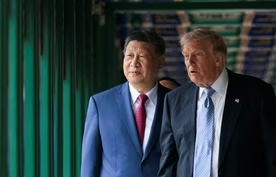
Did Xi get what he wanted out of Trump's China visit?
Video has Closed Captions
Did Xi get what he wanted out of Trump's China visit? (9m 51s)
Providing Support for PBS.org
Learn Moreabout PBS online sponsorship New Episode
- News and Public Affairs

Top journalists deliver compelling original analysis of the hour's headlines.

- News and Public Affairs

FRONTLINE is investigative journalism that questions, explains and changes our world.
 New Episode
 New Episode
 New Episode
 New Episode
 New Episode
 New Episode

 New Episode
 New Episode
Support for PBS provided by:
Major funding for “Washington Week with The Atlantic” is provided by Consumer Cellular, Otsuka, Kaiser Permanente, the Yuen Foundation, and the Corporation for Public Broadcasting.